

Over the past few months, I have been paying close attention to where Viva Engage is heading, especially after Microsoft Ignite. Between roadmap updates, deeper Teams integration, and a renewed focus on internal communications, something feels different this time. The Ignite announcements made me pause and take a closer look at a tool I have had a complicated history with, which is what pushed me to reassess where Viva Engage really stands today and where it could go next.
If you have never heard of Viva Engage, you are not alone. A lot of people still call it “that thing that used to be Yammer,” which is fair, because it literally is.
Yammer was hit or miss as a standalone social network. It lived outside the flow of work, adoption was uneven, and leadership often treated it like a broadcast channel instead of a conversation.
The value proposition is no longer ‘enterprise social.’ It is about giving organizations a place for conversations that actually matter, if they choose to use it intentionally.
That shift matters.
I will be honest. I have always struggled to sell Yammer, and later Viva Engage, in the organizations I worked in. I have also watched it struggle everywhere else. Part of that was the lack of an internal adoption strategy. No clear purpose. No ownership. No guidance.
Once Teams chats became the default for daily work, Engage often felt like extra noise. Another place to post. Another place to check. Like every new shiny thing, it got initial curiosity, then silence, then abandonment.
And here is the part people rarely admit. Organization after organization I worked with eventually turned it off. Small secret: I was usually the one who turned it off.
Then Microsoft rebranded Yammer to Viva Engage. A new SKU showed up in my admin center, turned on by default. And guess what I did next. Yep. Off it went again.
What adoption data actually tells us
Microsoft does not publish clean monthly active user numbers for Viva Engage, and that alone tells you something. But there are still signals worth paying attention to.
Microsoft has stated in November 2025 that Viva Engage drives over a quarter of a billion unique connections per week across the platform. That is not a vanity metric, it is Microsoft signaling volume and reach at enterprise scale.
At the same time, Microsoft Teams has surpassed hundreds of millions of monthly active users globally. Teams is the front door for work, whether we like it or not. Any engagement tool that lives outside of Teams will always struggle by default.
Do some more digging and you will find data from earnings calls and product blogs that employee experience, Viva, and AI-powered engagement are strategic growth areas inside Microsoft 365, not optional add-ons.
Translation. Viva Engage does not win on its own. It only wins when it is embedded, visible, and unavoidable inside Teams.
The problems Viva Engage is positioned to solve today
Poor communication during organizational change
Mergers, reorganizations, leadership changes, and policy updates still get buried in email and fast-moving chats. Employees end up confused, with no clear source of truth. This is exactly the type of problem Viva Engage is designed to address, by giving leadership a persistent, visible place to communicate and preserve context, when it is used intentionally.
Microsoft frames Viva Engage as the answer to leadership communication and organizational clarity. The tooling is there. Adoption is the hard part.
Low employee engagement
Most all-hands posts get views, not interaction. Engage is designed for reactions, comments, questions, and follow-ups.
Fragmented knowledge sharing
Answers live in private chats, meetings, and inboxes. Engage brings common questions and discussions into the open.
Missed critical updates
Important messages are often overlooked. Engage analytics provide better visibility into reach and interaction.
Why Teams integration changes everything in 2026
The biggest shift heading into 2026 is that Viva Engage is no longer trying to pull users into a separate app. It is meeting them where they already live.
Microsoft is rolling out Viva Engage communities directly into the Teams navigation, with synced membership, notifications in the Teams Activity feed, posting and interaction from Teams, and admin controls aligned with Teams governance.
Communities show up next to chats and channels. Conversations happen without app switching. Leadership posts surface where work already happens.
When Engage lives inside Teams, adoption stops being a change management problem and starts being a side effect of daily work.
Interested? Here is how to get started without guessing
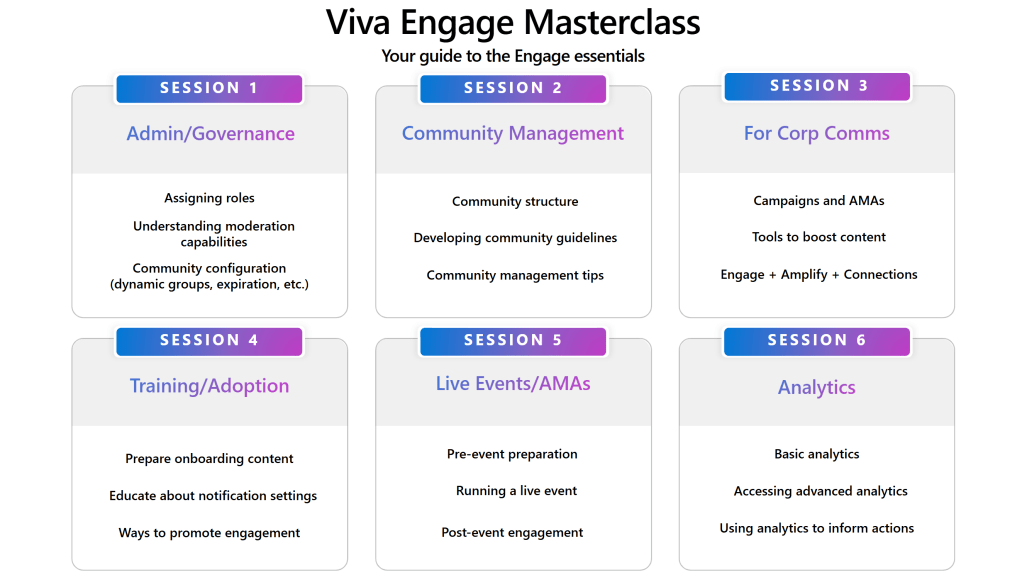
If you are responsible for internal communications, adoption, or governance and are not sure where to begin, Microsoft is running a Viva Engage Masterclass that covers the essentials. It is available on demand and also runs live starting Monday, January 26. It walks through core scenarios, patterns, and expectations for how Viva Engage is meant to be used today, which is far more useful than turning it on and hoping for the best. The sessions are broken up, each with its own supporting write-up and recording, so you can go through the full series or just focus on the parts that are actually relevant to you.
My hopes for Viva Engage in 2026
I have high hopes for Viva Engage, even though I have turned it off more than once. If it is going to stay on in 2026, these are the things that need to happen.
Less broadcasting, more listening
The tooling already supports two-way communication. Comments, reactions, questions, and follow-ups are all there. What’s missing is the mindset shift from broadcasting messages to actually engaging in conversations. Many organizations still post announcements and move on, instead of listening, responding, and treating engagement as part of the work, not an optional extra.
Clearer governance guidance
Admins and communicators need clear patterns for when to use Engage, Teams, SharePoint news, or Viva Amplify, because not every message belongs everywhere.
Stronger ties to Copilot and knowledge
Engage conversations are rich with real context from across the organization. Some of that already feeds search and AI today, but it needs to be more consistent and intentional across Microsoft 365.
Better signals for what actually works
Views are easy to count, but they do not show impact. Stop celebrating that 5,000 people “saw” a post if nobody engaged or acted on it. What matters is whether the message created clarity, sparked discussion, or led to a real decision or behavior change.
What this comes down to
Viva Engage has finally grown out of its Yammer shadow. The next step is making sure organizations use it intentionally, not accidentally.
If your internal communications still rely on email blasts and hope, you are already behind. Start experimenting with Engage inside Teams now. Define what success looks like. Design for engagement on purpose.
Otherwise, you will end up right where many of us were before, hovering over the toggle, ready to turn it off again.
That’s the cycle I’ve seen more than once. I’ve turned it off, turned it back on, and watched it evolve. What has your experience with Viva Engage been, and where do you see it going next?
 Unsuck Microsoft365